Recent posts:
-
Copulas and Tail Dependence
A portfolio can contain a hundred individually reasonable investments and still be one large bet. Mortgages issued in different cities might all depend on cheap refinancing. The individual risks look dispersed, but the circumstances that make them fail overlap. To understand diversification, we need to know both how bad each investment can get and how often they get bad together. We'll explore these concepts by looking at copulas, statistical objects that describe dependence between random variables.
-
On AI Research, Academia, and Competition
Research consumes scarce resources in exchange for uncertain knowledge. You commit time and effort to a promising scientific question, often with no upfront clarity on the potential discovery's utility and impact. What motivates such a choice? For an individual, curiosity and determination may be enough. However, here I'm more concerned with the institutional incentives that drive the research behavior of corporate and academic labs. Because whether the laboratory belongs to a university or a corporation, somebody must decide which questions deserve attention, somebody must pay, and somebody must judge the results. The recent AI boom, mixing both euphoric hype and fear of the technology, has been instrumental in amplifying the different mechanisms of corporate and academic research, enough so that the differences become evident.
-
Candlestick Tasseography
Modern technical analysis has roots in Charles Dow's studies of market trends at the turn of the twentieth century. Since then, chart reading has expanded into a large collection of numerical indicators built from prices and trading volume. Their appeal is understandable: markets aggregate news, expectations, and trading decisions into a price history, and indicators offer a compact way to describe its trends, momentum, and volatility. Traders use these descriptions to inform timing, execution, and risk decisions. But the leap from describing yesterday's pattern to predicting tomorrow's return makes the subject controversial, as the apparent regularities often end up being stories fitted to noise. That tension makes the tools worth understanding. In this fun little article we'll examine a few widely used indicators, explain their arithmetic, and connect them to the trading mechanisms behind price movements.
-
Virtualization and Deployment
A desirable thing in computer science is to decouple the program from its execution environment. Yet, a full abstraction of the low-level execution is likely impossible, so in practice the goal is more modest: to build deployment systems that provide consistent and predictable execution environments across different and potentially failing hardware machines. In concrete terms, the program needs CPU time, memory while it is executing, files and network connections, compatible libraries and configuration, and somewhere durable for the data that must outlive it. None of these is unlimited or inherently private. So how do we achieve reliable provisioning of these resources? Let's "re-derive" the current solution from the ground-up.
-
The Fundamental Theorem of Asset Pricing
What makes an uncertain promise worth something today? Is a price a forecast of the future, a measure of collective optimism, or an expression of how much we fear bad outcomes? Financial markets seem to bundle all of these forces into a single number. In that context the fundamental theorem of asset pricing is one of those deep theoretical results with enormous practical significance. It shows that, beneath that complexity, prices must obey a remarkably simple logic: consistent prices leave no room for a free lunch.
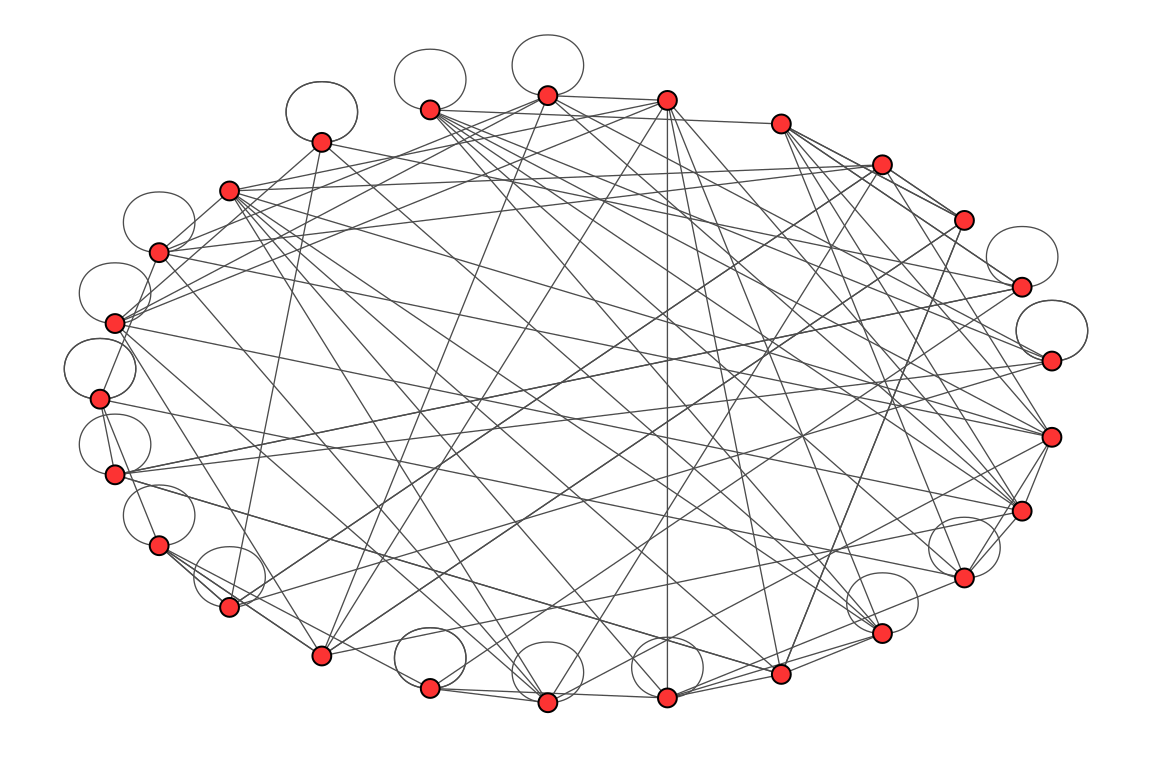
Every subset of less than half the total number of vertices has a proportionally large boundary of edges.