My Time in Singapore
I am very grateful to have had the opportunity to spend some time in Singapore. My first visit was a five-month exchange at NUS at the beginning of 2020, and it became perhaps the single most transformative experience of my life up to that point. I first heard about COVID-19 only a day after I landed; soon after, the pandemic began to escalate. Despite the fear and disruption, I stayed for the full semester. My second visit was much shorter and more recent, for AAAI-26. This post documents observations and thoughts from those visits - things I would consider too dear to forget.
In no particular order, some of the great things I saw:
- A bird's eye view of the Singapore Strait. Right as you land you can literally see oil tankers and freighters going through. The nearby Strait of Malacca, which continues right across Singapore, is the world's busiest oil transit chokepoint.
- The Jewel Changi Airport area, which blends the facilities of an airport, the convenience of a shopping mall, and the nature interior of a rainforest. It contains the largest indoor waterfall and a butterfly garden, among other things.
- The boutique hotel Amoy, where you enter through a former Chinese temple. The whole surrounding area is very eclectic, mixing traditional and new - Telok Ayer St with its heritage shophouses; Lau Pa Sat food court situated in the downtown core.
- Various religious points of interest. Buddhist temples such as Kwan Im Thong Hood Cho and Buddha Tooth Relic Temple resemble those in China with the presence of monks and the smell of incense. Seeing the ordinary people pray is a grounding, thoughtful experience. They're also interesting, with massive rooms full of little Buddha statues. Taoist temples like Yueh Hai Ching and Thian Hock Keng are somewhat similar but worship Taoist deities, immortals, and local gods instead of Buddhas and bodhisattvas. In one very small shrine, called Siang Cho Keong, I found a very curious and fun sequence of instructions for how to not anger the Tiger God. I also entered a Hindu temple, Sri Mariamman, which with its colorful interior offered an interesting contrast. Sultan Mosque, together with the surrounding area of Kampong Glam, offered yet another stark contrast.
- In Parkview Square, a massive office building in classic Art Deco style. Very surreal by modern standards. It's almost as if it came out of the Bioshock game.
- The downtown area is packed with beautiful places like Raffles Place, Clarke Quay, the waterfront promenade around Marina Bay, and the Esplanade building, shaped like a Durian.
Historical matters. I found the National Museum of Singapore a joy to explore. To summarize very briefly, a reasonable recollection of Singapore's history begins in the 14th century, as a thriving trading port, caught in a tug-of-war between the Siamese and the Javanese empires. In 1819 Sir Stamford Raffles arrived and founded a British trading post to challenge Dutch dominance in the region. Unlike other ports that charged heavy taxes, Singapore was a free port. This attracted thousands of immigrants from China, India, and the Malay Archipelago. In 1826, it became part of the Straits Settlements. From 1942 to 1945 Singapore was under Japanese occupation and suffered difficult times. The post-war years were marked by social unrest, communism, and a hunger for self-rule. In 1959, Singapore gained internal self-government. The People’s Action Party (PAP), led by Lee Kuan Yew (LKY), won the election. Singapore was briefly part of Malaysia, but in 1965 Singapore was expelled from the union against its own will. Since then, it has flourished into a modern rich state.
All of this is meticulously shown in the museum. The colonial section features cool rickshaws, natural history drawings by William Farquhar, and an opium den with wax figures of Chinese labourers. Now, when it comes to independent Singapore, we need to talk about LKY. He's a very sophisticated and complex character. They say he's a rare example of a benevolent dictator. I admire his extremely pragmatic long-term mindset. This, together with Singapore's need to survive among unfriendly neighbors and economic conditions, has motivated the country's policies. As a person, LKY was an *NTJ, iron-willed, intimidating, brilliant, and "uncommonly incorruptible". His commitment and conviction were absolute. Economically, he was a staunch advocate for meritocracy, free markets and foreign investment. He hated the idea of a welfare state, famously calling Singapore a "fair, not welfare, society."

Big picture economics. Singapore ranks among the freest economies in the world. There are virtually zero tariffs. There are no foreign ownership restrictions: a foreigner can walk in and own 100% of a company in nearly any sector, with zero repatriation limits on their profits. Setting up companies is quick and painless. There is no statutory minimum wage, and hiring/firing laws are highly flexible. There's no capital gains tax. The corporate income tax rate is flat. The judicial courts are efficient and incorruptible. Pretty good, right? However, there are also non-capitalist elements. There are big government-linked companies (GLCs), for example in the areas of aviation and telecommunication. The wealth is controlled by two colossal funds: Temasek, which invests in equity, and GIC, which manages foreign reserves. The government also owns 90% of the state land and leases it for 99 years to people meeting certain requirements.
How do we reconcile these seemingly opposite features? Well, the GLCs are government-owned, but the extent of their protection by special legislation is severely limited. They do have to abide by the market forces and make a profit in order to survive. It is mostly their long-term goals, trade-offs, and strategy, set by the government, that is different compared to private enterprises. In that sense, there is a healthy market, governed by freely-adjusting prices that enables efficient price-discovery and timely feedback. It's not like a planned economy where the prices are distorted or altogether missing. Of course, the housing market is an example where the government purposefully distorts the market so as to change the outcome to be more just, equitable, or aligned to its goals. But outside of public infrastructure, the state forces its corporate champions to sink or swim in the global capitalist ocean.
Cultural matters. In a strictly structural and political sense, Singapore is a textbook example of multiculturalism. Different cultural or racial groups exist side-by-side within a society, maintaining their distinct identities, traditions, and languages. The Singaporean government actively engineers society to reflect and protect this. That's why there are four official languages, racial quotas in public housing, and an emphasis on racial harmony and respect for the distinct religions and festivals. This is in stark contrast to countries like China (56 ethnicities, 1 culture) or Japan (~97% Yamato Japanese), which encourage the development of only one culture.
On the ground, Singapore also has elements of polyculturalism. This would be the organic, messy blending of cultures, with the clearest example being the Peranakan people and Singlish (Singaporean English) language. However, this is not explicitly sought by the government. LKY believed that peace and prosperity required boundaries, not a melting pot. He preferred a society where distinct groups retained their "pure" ancestral traits while uniting over a pragmatic, economic reality (English and capitalism), rather than leaving culture to mix organically and unpredictably on its own. In cases where religion enforces constraints that prevent the pragmatic integration with other cultures, LKY emphasized that a culture and religion must always be subservient to national survival and economic utility.
Monetary matters. I went to the Monetary Authority of Singapore (MAS) in the Tanjong Pagar area. The visitor center there presents the monetary history of the nation throughout the years, showcasing diverse notes and coins, and explains how the central bank works. In short, back in the 1820s there were many competing currencies in the region, circulated by traders, passing merchants, and locals: rupees, dollars, doubloons. The East India Company made attempts to monopolize the currency, facing severe resistance, but ultimately succeeded, introducing the Straits Settlements dollars (1898–1939). They were backed by Sterling, itself backed by gold for some time. Later on, a Malayan dollar was introduced (1939–1953), and then a Malaya and British Borneo Dollar (1953–1967). After Singapore split from Malaysia, it gradually adopted its own currency.
Singapore's a small country that heavily depends on trading with the outside world. If its exchange rate weakens, the general price level increases. Hence, to keep prices stable the MAS is targeting the exchange rate, not directly the interest rate. How does it work? First, a basket of trade-weighted currencies, for Singapore's trading partners, is defined. This index is called S\$NEER. The goal is to keep the SGD stable with respect to this basket. Then, a desired band is defined and the MAS acts to keep the SGD within this band by selling or buying SGD in the open foreign exchange markets. By deciding when to intervene, the MAS controls the slope, the level, and the width of the band. An appreciation in SGD makes imports cheaper and exports more expensive, which cools down domestic demand and inflation.
Thus, in the spectrum of the impossible trinity, Singapore has chosen a managed exchange rate and completely free capital movement, at the expense of a strictly independent monetary policy. Interest rates are set by uncovered interest parity based on US rates and the SGD's trajectory.
NUS. My experience at NUS was entirely positive with so many fond memories. The humid air, the heat, the thunderstorms, the green expansive campus itself, the labs, the study rooms, the different buildings, the MRT rail to the campus. It's all imprinted deep into my brain matter now. During my exchange I intentionally chose my classes to be from different departments so I would have to walk from one building to another. I saw semi-autonomous vehicles driving around the campus grounds. In fact, Motional's dataset Nuscenes was in part collected there. In my second visit to Singapore, I didn't come as a person to be taught, but as one to teach others. I visited the lab, presented my research, met and discussed with other fellow researchers.
Accommodation. During the first, long stay in Singapore I was living at Tiong Bahru, in a beautiful residential area close to the Tiong Bahru plaza. When COVID hit, because of the remote attendance I remember that my biological clock had adjusted: I would stay up late during the night and sleep until 10am. During those hot nights I would sometimes go on long night walks along the empty quiet streets. In my second visit I went back to Tiong Bahru to reminisce about the precious past. I went to the mall, walked the same footpaths as before and sunk into the nostalgia of revisiting one's home from a distant past.
Hiking and nature. Lots of cool places here. I'm happy I got to see certain key nature areas:
- The Botanical Gardens contain the largest and most diverse collection of flora I have ever observed: arboretums, swamps, jungles, orchids, bonsai, bamboo, you name it, it's present. Lots of freely roaming, harmless monitor lizards too.
- Gardens by the Bay. Similarly green and diverse, it's a joy to explore during both day and night. I like the cactus garden and the Supertree Grove tree.
- A place called Labrador Nature Reserve, which offers a peaceful coastal walk with views of the dock and the ships. I saw not less than twelve wild monkeys there!
- Mount Faber is the second or so highest point in Singapore. I've climbed it twice. At the top there's a supreme view of the docks and the city skyline along with a majestic big tree creating a contemplative zen atmosphere. From there, one can reach Henderson Waves and the trails in the Southern Ridges. The second time I was there the sun set and I found myself, in the midst of my journey, on a dark path with unheard alien bird calls screeching around me. It was cool.
- Bukit Timah Nature Reserve offers the highest point. It's a short steep climb up to the summit. But it's worth it, as you can see monitor lizards and the reservoir that used to be a quarry but is now full of rainwater.
- Sungei Buloh Wetlands is a cool place to the north, close to the border with Malaysia. I went there to explore and saw numerous monitor lizards, an otter, and an actual wild crocodile.
- MacRitchie Reservoir. This place offers a proper long hike in a real tropical jungle biome. I saw a snake, a giant millipede, monkeys, swamps, and cicadas when I did it. The ultimate highlight was the treetop walk!
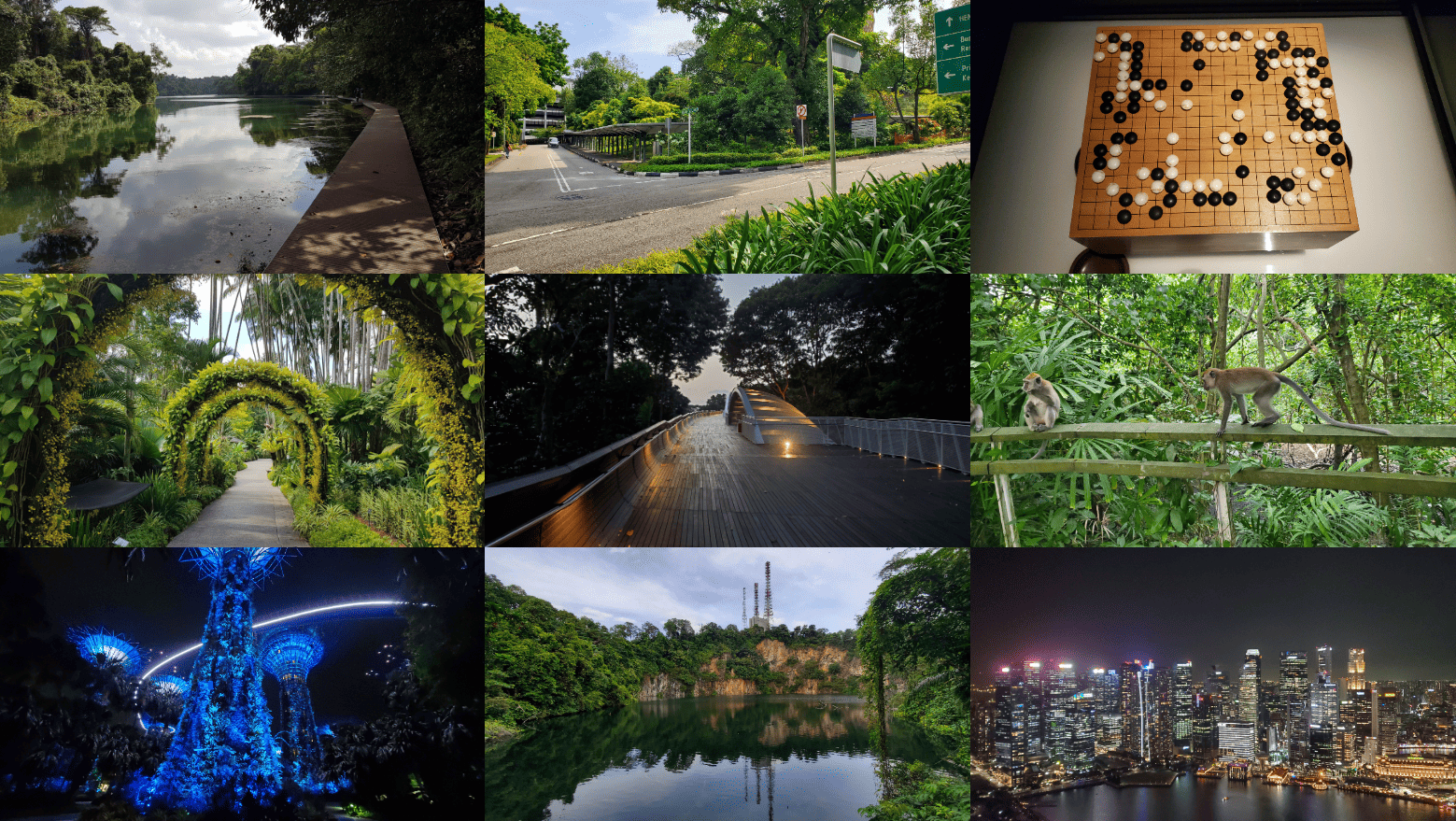
City sights. Apart from hiking, there are city sights you don't want to miss. I particularly liked the gardens around the durian-shaped Esplanade and the Marina Bay area itself. Back in January 2020, when people were celebrating the Chinese New Year, I was there, on that promenade! Nearby, on the corner of the War Memorial Park, there's an underground crossing where skaters and breakdancers gather and play the freshest, happiest beats (think something like Avalanches - Since I Left You, for lack of better comparison). Nearby is the Swissôtel The Stamford, where I'll remember what it's like to dine on the 70th floor.
Another important moment was visiting the East Coast Beach. It's a niche little achievement to have dipped your feet into a body of ocean that connects to the South China Sea. The water there was surprisingly clear and pleasant. Close by is a cool residential area that is traditional in style, with Peranakan architecture and pastel-colored shophouses. From the beach you walk north along Joo Chiat, then turn west on Geylang Road, and then north to Paya Lebar Square. It's one of the most authentic areas in Singapore, offering enthralling views and at least to me, memories of hot summer days and blissful holidays.
Last day. My last full day in Singapore was spectacular and will be remembered. I spent a long time at the Asian Civilisations Museum, curiously learning about different countries' maritime trade routes, competitive advantages, and cultural practices. I looked at ornamental pottery, golden treasures and jewellery, beautiful paintings, cursed daggers and weaponry, statues of revered men and mythical deities, musical instruments, and board games. That last one was the best. There were Go, chess, mandala, snakes and ladders, shogi, and other board games. I beat an actual mechanical robot at Go. The details will be omitted.
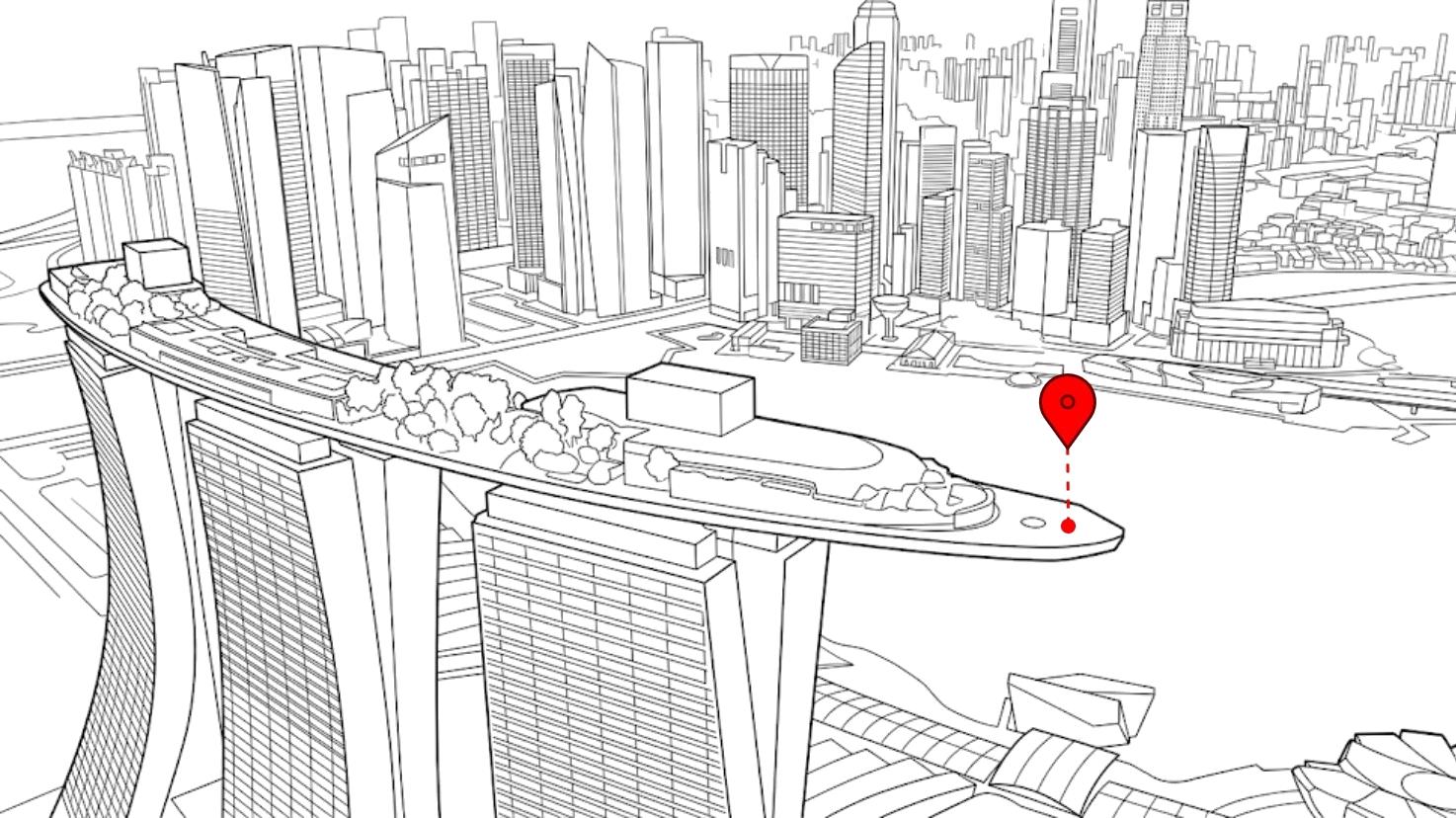
After the museum I went to the SkyPark observation deck, on top of the Marina Bay. The view is, naturally, glorious, covering the nearby skyscrapers, the gardens, and the Singapore strait, dotted with freighters and vessels. After the observation deck closes (can't leave earlier), you go to Gardens by the Bay, for an exclusive nighttime tour. Some of the areas are closed, like the Cloud Forest, but the outdoor ones remain open until early into the next morning. The SuperTree Grove is illuminated by colored blue lights, making it resemble an alien planet, with alien vegetation.
Overall, Singapore was an insanely memorable destination and I am glad I have managed to explore it as much as I did. From the meticulous organization to the voodoo shamans that you can encounter in the subway, it was well worth the visit.