Impressions From the Far East
This is the crazy story of my time in China, attending the IROS 2025 conference. I spent ten days across Hangzhou and Shanghai and found this experience very enriching and memorable. Here I'll cover mostly the cultural aspects, of which there are plenty. There will be a separate blog post on the current trends in robotics.
My first impressions of Hangzhou were focused on how green it is and how cyberpunky it feels. When the sun set that first day I felt a little culture shock, just from walking in the rain surrounded by dark green vegetation, canals, and people vocalizing words of wildly-unknown semantics. Yet, I had the might of modern technology at my fingertips.
The city is well-organized. Transport is smooth, with subways and buses being straightforward and intuitive. Signs, markings, directions are all displayed exactly where you'd expect them to, making it easy to navigate, even as a foreigner. The language barrier wasn't too bad. What really helps is, first, the romanization system because it translates Chinese symbols to Roman (Latin) script, allowing you to hold entire words in your head and match based on "internal vocalization". That is, you don't have to match words symbol-by-symbol. Second, what also helped was Google Translate in live camera mode, where the translation directly interfaces the image.
Hangzhou is awesome. Green, shady, and humid. It blends technology and nature. Many devices try to talk to you - buses, subway systems, traffic lights, gates, video walls, elevators, escalators. The playback messages repeat often, so you're constantly bombarded by prompts of all kinds. It's very interesting. It's also dense with more than 12 million people. There are traditional Chinese architectural elements - moon gates, and upturned eaves. At Longxiangqiao, the city center, every building is a shopping mall with multiple levels, above and below ground, and you can move from one to another without going above surface. Locations there are described using both a level and a sector. Food courts are on the lower levels. There are many cameras, everywhere, hundreds of millions in all of China. They use AI monitoring and ID-linked digital activity to track citizens. There's lots of security personnel too. It tacitly suggests that you should behave in a calm, civilized manner.
China takes great care in protecting its national culture. There are 56 ethnicities recognized, but the state promotes only one dominant national culture, Han-centered. I won't discuss the political aspects in too much detail. Overall, the goal is stability, unity, and economic growth. Expressive freedom is second-hand. That being said, their society is very efficient in infrastructure, digital governance and logistics, due to centralized decision-making, scale, and investment. They have a mentality of getting things done without complaining. It's a peculiar mix of modern convenience under tight ideological discipline.
I spent a full day exploring the Xihu area. It's very beautiful. It's tidy and green, with lush vegetation, camphor trees with thick, gnarled, twisting branches, and water lilies. Starting from Longxiangqiao you walk north and hike up to the Baochu Pagoda, which offers a few nice vistas of the city and the West Lake. You then follow a shady trail within the forest of the hills, passing through various landmarks like Hama Peak and the Taoist Baopu Temple. There are interesting caves too. In a spot called Ziyun Cave you can descend into a big semi-open cave with two Buddhist altars carved into it. Near another altar called Quxia cave I remember seeing some locals playing cards, while another one was loudly bickering with two security officers. After descending the hills one reaches Yue Fei's temple. He was a military general during the Song dynasty who fought the Jin.
From there I went to the Hangzhou Botanical Garden which was splendid. It's a huge area consisting of all kinds of pleasant greenery - swampy wetlands, grassy plains, bamboo forests, arboretums, bonsai gardens, etc. Close by is the Buddhist Lingyin Temple which was the highlight of Hangzhou. Let me try to paint a picture: giant decorative censers where incense is burning, smoke rising into the air, evergreen pines, leaves rustling, chimes producing melodic sounds from the howling wind, and monks, lots of them. I was lucky enough to see them perform a chanting scripture. I was utterly mesmerized. This was one of the greatest cultural experiences I've ever had. It was peaceful and humbling, like a deep forgotten realization that suddenly changes everything. Godlike sounds, calling wisdom, karunesh.
The Lingyin Temple itself was amazing, filled to the brim with statues of almighty heroes and venerable deities. The whole area is a temple complex. Nearby, the Yongfu Monastery was the next best thing with its peace and tranquillity. This is where I first noticed the pattern of having cats roam freely around the temples. These Buddhist cats are wise and methodical. They choose the path of peace, instead of violence. It was getting dark, so I headed back to the hotel.
The next day I returned to continue the exploration. I heard another set of monks at Yongfu, climbed Feilai Peak, and saw the statues carved into the limestone cliffs and grottoes. It was all amazing, unlike what followed. The next destination on my list was the National Tea Museum, just 20 minutes away on foot. It was a big mistake to walk there, as for the first time in my life I had to go on foot through a 500-meter tunnel. Luckily there was a pedestrian walkway and I only had to mind the scooters and e-bikes. The tea museum was nice and I got to see lots of teas of different colors and textures, along with the history of tea-drinking in China, and even some real Longjing tea fields. Next was the Hupao Park, another calm and tranquil area evoking meditations and contemplations. I saw at least twelve giant silkmoths, hibernated and sleeping over a few lamps and tree branches.

The IROS conference was well organized and diverse. I saw interesting presentations and had lots of fun presenting my own work. In the exhibition area there were many robots, of all kinds - wheeled, legged, quadrupeds, drones, bio-inspired, for manipulation and navigation. I spent hours watching robot boxing. Don't worry these robots are not autonomous yet. They are teleoperated by humans and the various motions of kicking, punching, getting up from a knockdown, dancing, taunting, are hardcoded. There were some epic strikes and lots of clumsy staggers.
The conference venue was impressive. First, the scale was astounding. Even with close to 10K total participants it still felt sparse when having to walk from one hall to another. Second, at the top of the venue there was a garden, or rather a park, providing a green scenery of well-maintained trees and shrubs. Lastly, the area around the venue, called Xiaoshan, was intriguing. Big streets, large business buildings, overall a futuristic downtown vibe.
On the next day I went to explore more of Hangzhou. First stop was the Leifeng Pagoda, towering over the nearby forests and hills. The whole area is beautiful, with lush green vegetation and decorative ponds. Right against it stands Jingci Temple, a smaller variant of Lingyin yet with similar grandiose ambience. My next object of interest was rather quirky and uncommon for a foreigner. I went to the Finance and Taxation Museum. As an avid economics fan, I found captivating the story of how China's taxation has evolved throughout the ages. Here are some things I realized. First, compared to Europe, ancient Chinese peoples seem to have put up considerably less resistance to the imposition of taxes. As a result, the political tendencies to centralize taxation have been occurring far earlier than in Europe. And taxation has been evolving, from dynasty to dynasty, in a relatively consistent way. Tax policy was and still is viewed as a tool for state capacity, stability, and development, not only revenue.
I had the impression that the museum was surprisingly frank in labeling historic periods of political instability and weak centralization as bad and chaotic. In turn, those historical events of unification, through which a single strong political entity is established, are viewed as beneficial, contributing to stability and tax uniformity. Due to strong influences of Confucianism, historically taxes were mostly land-based and relatively light (ruler should not burden farmers excessively). Taxes were seen as a reciprocal duty between rulers and subjects, not a contractual rights-based system. Their legitimacy was tied to benevolence and restraint in taxation. Overall, Confucianism favours hierarchy, meritocratic bureaucracy, moral governance, filial piety, harmony, emphasis on education and exams. It is central for understanding officials’ self-image and social expectations.
Subsequently I went to the Chenghuang pavilion in Hangzhou. Chenghuang refers to the City God and embodies the idea that cities have moral and administrative spirits, structured like the imperial bureaucracy. It reinforces civic identity and links earthly governance with a supernatural regulatory order. In Hangzhou the pavilion stands tall in the southeastern part of the city, on a green hill. It was one of the most calm and peaceful gardens I've ever set foot in.
There are a few other interesting locations that deserve to be documented. First, the CBD area, called Qianjiang New City, is beautiful. Go there at night, walk the pedestrian platform along the Qiantang River and you'll quickly be convinced. Second, the former residence of Hu Xueyan is awesome, it's a labyrinth of caves, rooms, gardens, and ponds, all enclosed compactly between four large walls. Lastly, a colorful and memorable event is Impressions West Lake, a musical and dance performance on a dynamic, movable stage 3cm below the surface of the West Lake. It had its good parts. It also featured the theme from Swan Lake and a nationalist propaganda song.
Now, onto Shanghai, Magic City. I spent three nights there. It had an entirely different ambience compared to Hangzhou: the scale is enormous, there's less emphasis on nature and ancient civilizations, and feels like a Western city. First big treat was my hotel. By the kindness of the receptionists' hearts, they had decided to promote my room to a penthouse. So I was at the tenth floor, near East Nanjing Road in a luxury apartment with a private balcony and a splendid city view.
Shanghai is a very interesting place. In the morning I saw a person doing tai chi next to an English church. At the Jade Buddha Temple I saw Buddhist statues, evergreen trees, and incense burners. The statues of sitting and reclining Buddhas were made of marble and jade, imported from Singapore and Myanmar. The next temple was Jing'an, tucked within the Shanghai skyline. I took my time there to really soak in the atmosphere. It's crowded and lively. Lots of people bustling around, some kneeling and praying. There's a large iron urn in the courtyard where it's common to throw coins, hoping they either land inside or make a ringing sound. With stronger winds, the incense ash starts flying all around. In the Mahavira Hall there's a 3-ton silver Buddha statue, contrasting the mostly wooden interior. Overall, it's a thought-provoking place. It triggers realizations.
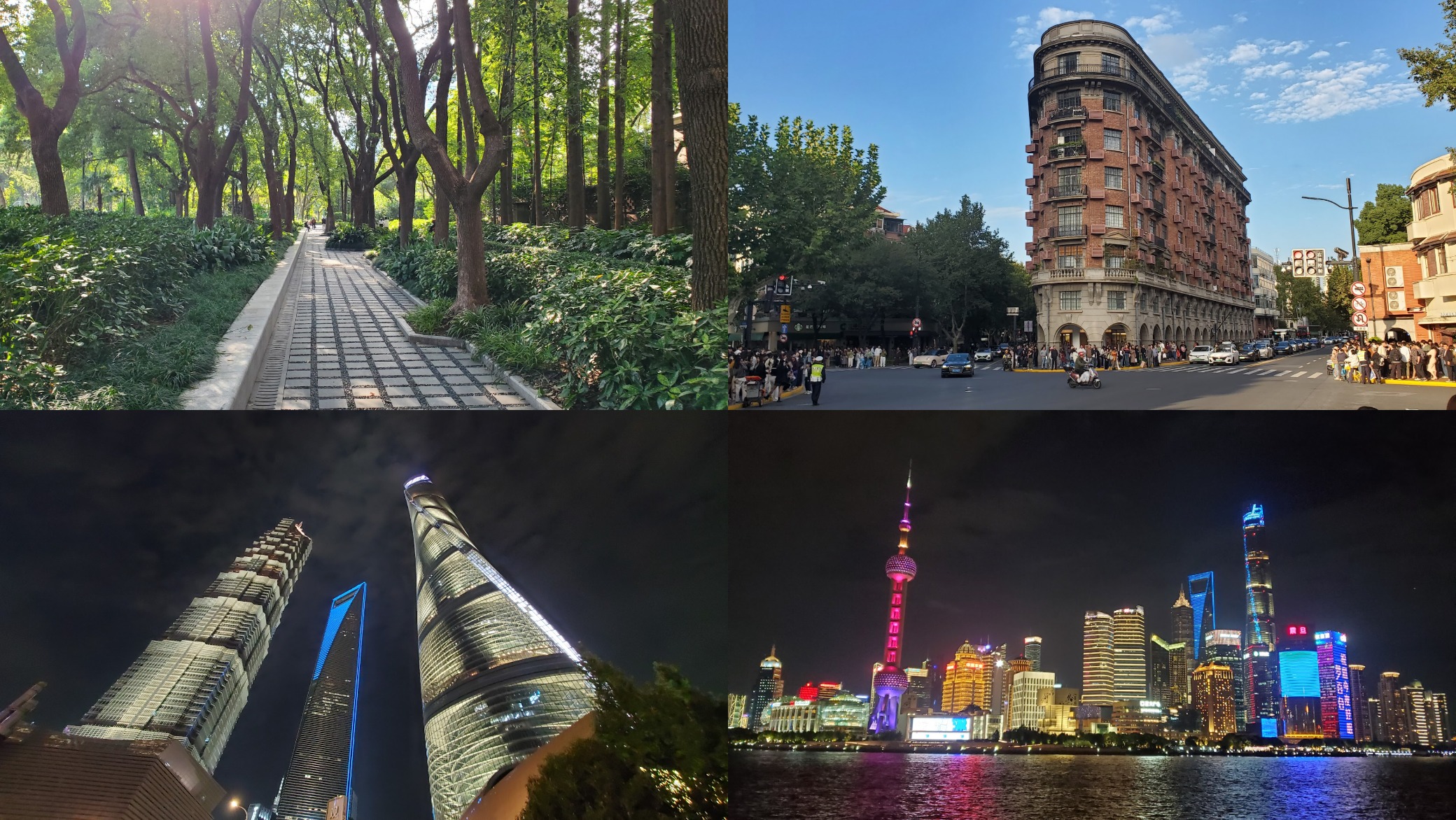
Another interesting site is Tianzifang, a labyrinth of tight streets, full of boutique and handcraft shops. Close by is Fuxing Park, a beautiful green park, featuring well-kept grasslands, ponds, an alley covered in overhead vines, and a statue of Marx & Engels, among other things. This whole area is called the French Concession, because it was a French-administered concession from 1849 to 1943. It also features the awesome Wukang Road building.
Yet another cool place is Longhua Pagoda and the surrounding temples. While it features the typical Buddhist aesthetic, I'd like to emphasize the amount of cats there. One of them was meditating indoors. I also visited the Chenghuangmiao, which is a Taoist, not Buddhist, temple. The difference is that Buddhists worship buddhas and bodhisattvas, whereas Taoists worship other gods like the Jade Emperor. Buddhist temples are often quieter, contemplative, whereas Taoist ones are more ritualistic, often linked to festivals or folk religion. They also display more humanlike characters - elders, warriors, planners.
But the highlight of Shanghai was the downtown area, Pudong. It features some iconic buildings: the Oriental Pearl, Jin Mao, the Shanghai World Financial Center, which is the highest building with a hole in it, and the Shanghai Tower, the highest twisted building in the world, third by overall height, and second by observation deck height, as of 2025. Of course, I had to climb up there. The view from the 119th floor was glorious. Your legs feel weak and shaky up there. What's even cooler is you can go up to the 126th floor, where there's a tuned mass damper, a device that absorbs the vibrations from strong winds and minor earthquakes, reducing the sway of the building. Basically, when wind pushes to one side, the damper, which is a huge suspended weight, is moved to the opposite side. This phase opposition converts kinetic energy into heat through friction or hydraulic resistance in the damper system. The energy is dissipated, so the sway amplitude decreases.
The most important thing to do in Shanghai is to walk the Bund at night and see the city lights. It's crowded but not without reason. This waterfront area offers a condensed mix of landmarks and architectural styles (colonial west of Huangpu River vs modern to the east).
Overall, my 10-day trip in China was a very immersive, rewarding experience. Hangzhou was techno-natural. Shanghai was urban, with strong Western nuances. I got to know the country and saw some of its wonders. I feel distinctively better off compared to what I would've been, had I not explored it.